

ByJohn A
Hexarelin or Ipamorelin: What the Numbers Actually Separate
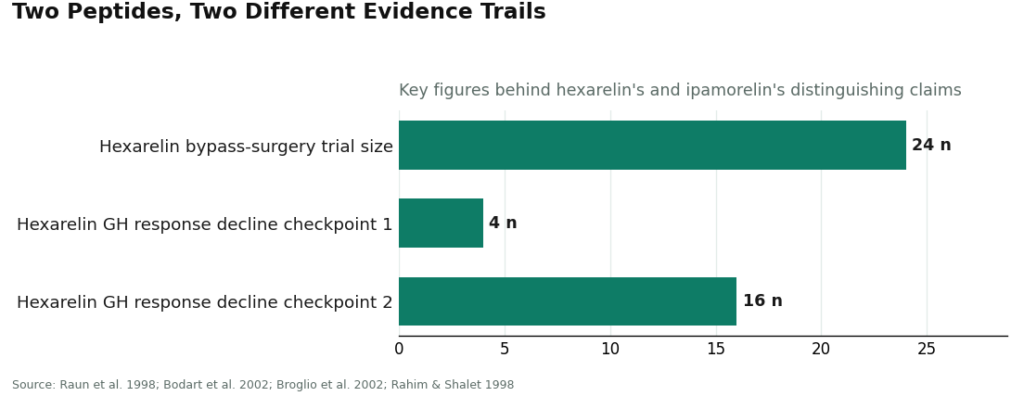
Twenty-four. That’s the size of the human trial behind hexarelin’s whole cardiac story, the one part of its evidence file that isn’t rats or cell cultures. Twenty-four coronary-bypass patients, one acute dose apiece, one operating room [3]. I keep coming back to that number because it tells you something the marketing copy for either peptide never will: how much weight the evidence is actually built to carry, and where.
Both peptides discussed here are research-stage compounds, not approved drugs, and that fact should sit under everything that follows.
Hexarelin and ipamorelin get lumped together constantly, and on paper I understand why. Both are synthetic growth hormone secretagogues. Both work on the same receptor, the growth hormone secretagogue receptor, to squeeze a pulse of growth hormone out of the pituitary. Both are injected under the skin. Both get pitched to roughly the same audience for roughly the same reasons. If you only read the category label, you’d assume you could swap one for the other.
You can’t, and the reason isn’t vibes, it’s data. The two compounds were built and studied to answer different questions, and the numbers behind each one point in different directions.
The one thing they actually agree on
Strip away everything else and both molecules do the same base-level job: bind the receptor, trigger the pulse. If your only question is “will this raise growth hormone in the short term,” both answer yes, and the comparison stops mattering.
But growth hormone release was never the only thing either molecule touches, and that’s where I think the real comparison starts. The two diverge sharply in what else moves alongside the pulse, and that divergence sorts them into two different jobs.
Ipamorelin’s number: nothing else moves
Ipamorelin’s whole reason for existing is selectivity. It was designed, deliberately, to lift growth hormone without dragging other hormones along for the ride.
The 1998 paper in the European Journal of Endocrinology that introduced ipamorelin is where this gets pinned down. The researchers found ipamorelin released growth hormone with a selectivity comparable to growth-hormone-releasing hormone itself, and, this is the part I find genuinely notable, it did not push ACTH or cortisol above baseline stimulation even at doses far beyond what was needed for the growth hormone effect. The same paper reported no meaningful movement in prolactin, FSH, LH, or TSH either [1]. So the number that matters here isn’t a peak GH value, it’s a flat line everywhere else.
That flat line is ipamorelin’s strongest, most direct piece of evidence, and it tells you exactly who the peptide is for: someone who wants the cleanest possible growth hormone signal and as little hormonal noise around it as this drug class permits.
Hexarelin’s number: a receptor in the heart
Hexarelin’s most distinctive evidence has nothing to do with a cleaner GH curve. It points somewhere else entirely, into cardiac tissue.
A 2002 study in Circulation Research identified CD36 as the cardiac receptor responsible for the cardiovascular action of growth-hormone-releasing peptides, hexarelin included, and it showed dose-dependent effects on coronary perfusion that simply vanished in animals lacking CD36 [2]. That’s mechanism. Then there’s that trial I opened with: 24 coronary artery disease patients getting acute hexarelin during bypass surgery, with researchers observing prompt improvements in left-ventricular ejection fraction and cardiac output that didn’t look growth-hormone-driven [3]. A 2014 review in the Journal of Geriatric Cardiology gathers this whole line of work and calls hexarelin a possible future therapeutic direction, while stating clearly that’s all it currently is [4].
I want to be careful here, because it’s tempting to read “cardiac” and hear “heart medicine.” It isn’t one. It’s a real, published, mechanistically-supported finding at the research stage, built on animal data plus one small human trial. That’s a genuinely different evidentiary shape than ipamorelin’s selectivity work, and it’s the cleanest point of separation between the two compounds.
The honest but
Here’s where the comparison gets less comfortable, and where I think a lot of side-by-side pieces go soft.
The same busyness that makes hexarelin interesting to cardiovascular researchers is the same busyness that makes it a messier general-purpose peptide. Hexarelin belongs to an older, less selective generation of secretagogues than ipamorelin, and the fact that ipamorelin’s clean profile was treated as a breakthrough tells you what came before it wasn’t clean. Hexarelin is understood to raise cortisol, nudge prolactin, and act directly on cardiac tissue in ways that have nothing to do with growth hormone at all. None of that automatically means unsafe. It means more systems are in play, and more things a clinician would want to track.
So the trade-off, stated plainly: ipamorelin buys you selectivity at the cost of not having hexarelin’s cardiac story. Hexarelin buys you that unusual cardiac mechanism at the cost of being less selective and more hormonally active. I don’t see a way to call one of those strictly better. They’re built for different jobs.
The clock hexarelin runs on
There’s a second cost specific to hexarelin, and it’s a timing problem, not a hormone problem.
A 1998 study in Growth Hormone and IGF Research found that with continuous use, hexarelin’s growth hormone response dropped by week four, dropped again by week sixteen, and only came back after a break from dosing [5]. That’s desensitization, documented and specific to this compound. It means how you cycle hexarelin isn’t a footnote, it’s close to the whole game. A dosing plan that ignores this finding is ignoring the single piece of hexarelin evidence most likely to determine whether the compound keeps doing anything at all after a month or two.
I’m not claiming ipamorelin is somehow immune to every form of receptor adaptation, that’s a bigger pharmacological question than either of these two papers settles. What I’m saying is narrower: for hexarelin specifically, this finding is published, specific, and it has to be weighed.
Matching the peptide to the question, not to a ranking
Add it up and the comparison doesn’t sort into a winner. It sorts into a match.
If your priority is the cleanest achievable growth hormone signal with the least collateral hormonal noise the class allows, the selectivity evidence points at ipamorelin, directly [1]. If your interest is specifically hexarelin’s cardiac mechanism, the differentiating research runs that way too [2][3][4], with two caveats attached: it’s research-stage, not an approved use, and it’s the busier, less selective, cycling-sensitive compound of the two [5].
What the evidence won’t support is a flat “X beats Y.” Anyone selling that framing is claiming more certainty than a 24-patient surgical trial and a single 1998 selectivity paper actually give them.
There’s also a layer no article, mine included, can resolve on the page: whether either compound makes sense for a specific person, at what dose, on what cycle, given that person’s full medical history. That’s a clinical judgment, not a spec-sheet exercise. A supervised provider such as FormBlends works on physician oversight and legitimate pharmacy-channel sourcing, which is the difference between a licensed clinician weighing hexarelin or ipamorelin against your actual history and a research vial showing up with no oversight attached. I mention FormBlends here as an example of that supervised model, not as a verdict on either peptide, because neither is proven for general use.
One more number closes the loop for a chunk of readers and makes the whole comparison moot: both hexarelin and ipamorelin sit inside the growth hormone secretagogue category the World Anti-Doping Agency prohibits at all times. If you’re a tested athlete, there’s no decision to make here, both are banned, and the current prohibited list is worth checking directly rather than trusting anyone’s summary of it, mine included.
So, the tally. Hexarelin and ipamorelin look identical at the category level and split apart at the level that actually matters: what the evidence says each one does beyond the GH pulse. Ipamorelin’s strongest number is a flat line across cortisol, ACTH, and four other hormones. Hexarelin’s strongest number is a receptor in cardiac tissue and a 24-patient surgical trial, with a desensitization clock ticking underneath it. Pick based on the question you’re actually asking, and bring a clinician who can see past the spec sheet.
The questions that keep coming up
Does hexarelin or ipamorelin raise growth hormone more?
Hexarelin tends to produce a bigger acute GH pulse, which is part of why it drew so much early research interest. But peak size isn’t the number that should decide this for most people. Ipamorelin gives up some of that peak in exchange for a cleaner hormonal profile, and hexarelin’s response fades with continuous dosing, so whatever wins on day one doesn’t necessarily win across a full cycle.
Why doesn’t ipamorelin raise cortisol the way hexarelin does?
Because it was built not to. The 1998 characterization study found ipamorelin held its selectivity, no meaningful ACTH or cortisol rise, even at doses well above what it needed to move growth hormone [1]. Hexarelin comes from an earlier, less selective generation of secretagogues, so cortisol and prolactin move along with it. That gap is a design decision, not a dosing mistake.
Does hexarelin’s effect on the heart mean it’s good for cardiac health?
The signal is real, but it’s research-stage, not a cleared use. Hexarelin acts through CD36 in cardiac tissue independent of growth hormone, and both the animal work and a small bypass-surgery trial recorded improvements in cardiac performance [2][3]. A 2014 review frames this as a possible future direction, not an established treatment [4]. The honest read: an interesting mechanism, not a proven therapy.
Why does hexarelin stop working the longer you use it?
Desensitization, and it’s one of the best-documented quirks in the hexarelin file. A 1998 study found the GH response dropped by week four, dropped again by week sixteen, then recovered after a dosing break [5]. Practically, that means how you cycle hexarelin matters more than it does for a lot of other peptides. Run it continuously and you can erode the very effect you’re chasing.
Can a drug-tested athlete use either of these?
No. Both sit inside the growth hormone secretagogue grouping the World Anti-Doping Agency bans at all times, so for a tested athlete the comparison never gets off the ground, both are prohibited. Check the current prohibited list directly rather than taking any article’s word for it.
So how do you actually choose between them?
Let the question decide the trade-off. Cleanest possible GH signal with the least collateral hormone activity: the selectivity evidence points at ipamorelin [1]. Specific interest in hexarelin’s cardiac mechanism: that’s the compound the differentiating research follows, with the understanding that it’s busier, less selective, and far more sensitive to cycling [5].
What is hexarelin and how does it actually work?
It’s a synthetic six-amino-acid peptide that mimics ghrelin and binds the GHS-R1a receptor in the pituitary and hypothalamus, triggering a growth hormone pulse. Unlike natural ghrelin, it was engineered for potency at that receptor rather than for appetite signaling. It also binds a separate receptor in heart tissue, which is exactly why the cardiac research exists in the first place.
What dosage shows up in the actual hexarelin research?
Most published human work used intravenous or subcutaneous doses in the 1–2 mcg per kg range for acute GH-stimulation testing. Longer clinical protocols have generally stayed toward the lower end of that range, precisely because hexarelin desensitizes faster than gentler secretagogues do. There’s no established optimal schedule for general use, so treat any claim of a universal “right dose” with suspicion.
What side effects turn up with hexarelin?
The most consistent findings in human studies are elevated cortisol and prolactin riding alongside the GH rise, which can show up as water retention, increased hunger, or a flatter mood in some people. Transient flushing and fatigue have also been reported. Desensitization itself functions as a kind of side effect, since it caps how long the compound stays useful. Longer-term safety data in healthy adults simply doesn’t exist in the published literature.
Is hexarelin legal to buy, and does the source matter?
It’s not approved as a drug in the US, EU, or most other places, so there’s no legal over-the-counter route. It sits in a gray zone: possession is rarely prosecuted, but selling it for human use isn’t permitted. Research-chemical vendors fill that gap with no quality guarantees attached. A physician-supervised compounding pharmacy such as FormBlends offers the accountable alternative, where identity and purity can actually be verified and a licensed provider is part of the decision.
See also: What Are the Most Secure Blockchain Networks?
References
Every reference below was verified directly against its PubMed record. Open any of them and check it yourself.
- Ipamorelin released growth hormone with a selectivity comparable to growth-hormone-releasing hormone, without raising ACTH or cortisol above baseline stimulation even at high doses, and without meaningfully affecting prolactin, FSH, LH, or TSH. Raun et al., European Journal of Endocrinology, 1998. https://pubmed.ncbi.nlm.nih.gov/9849822/
- CD36 identified as the cardiac receptor mediating the cardiovascular action of growth-hormone-releasing peptides including hexarelin; dose-dependent coronary perfusion effects, absent in CD36-null animals. Bodart et al., Circulation Research, 2002. https://pubmed.ncbi.nlm.nih.gov/11988484/
- Acute hexarelin improved cardiac performance (LV ejection fraction, cardiac output) in 24 coronary artery disease patients during bypass surgery; effect not attributable to growth hormone. Broglio et al., European Journal of Pharmacology, 2002.
- Review of the cardiovascular action of hexarelin including CD36-mediated cardioprotection; framed as a possible future therapeutic direction, not an established treatment. Mao, Tokudome, Kishimoto, Journal of Geriatric Cardiology, 2014.
- With repeated continuous use, the growth hormone response to hexarelin declined by week 4 and again by week 16, recovering after a break; the basis for hexarelin’s desensitization caveat. Rahim & Shalet, Growth Hormone & IGF Research, 1998.
Written by Nadia Petrova, health-data reporter. Following the evidence to its honest limits. Last reviewed February 2026.
For general readers, not a prescription. Check in with a qualified clinician before you begin.
